
Calhoun County Storytellers: Kurt Thornton
By Lucy Hough / For Black Squirrel News
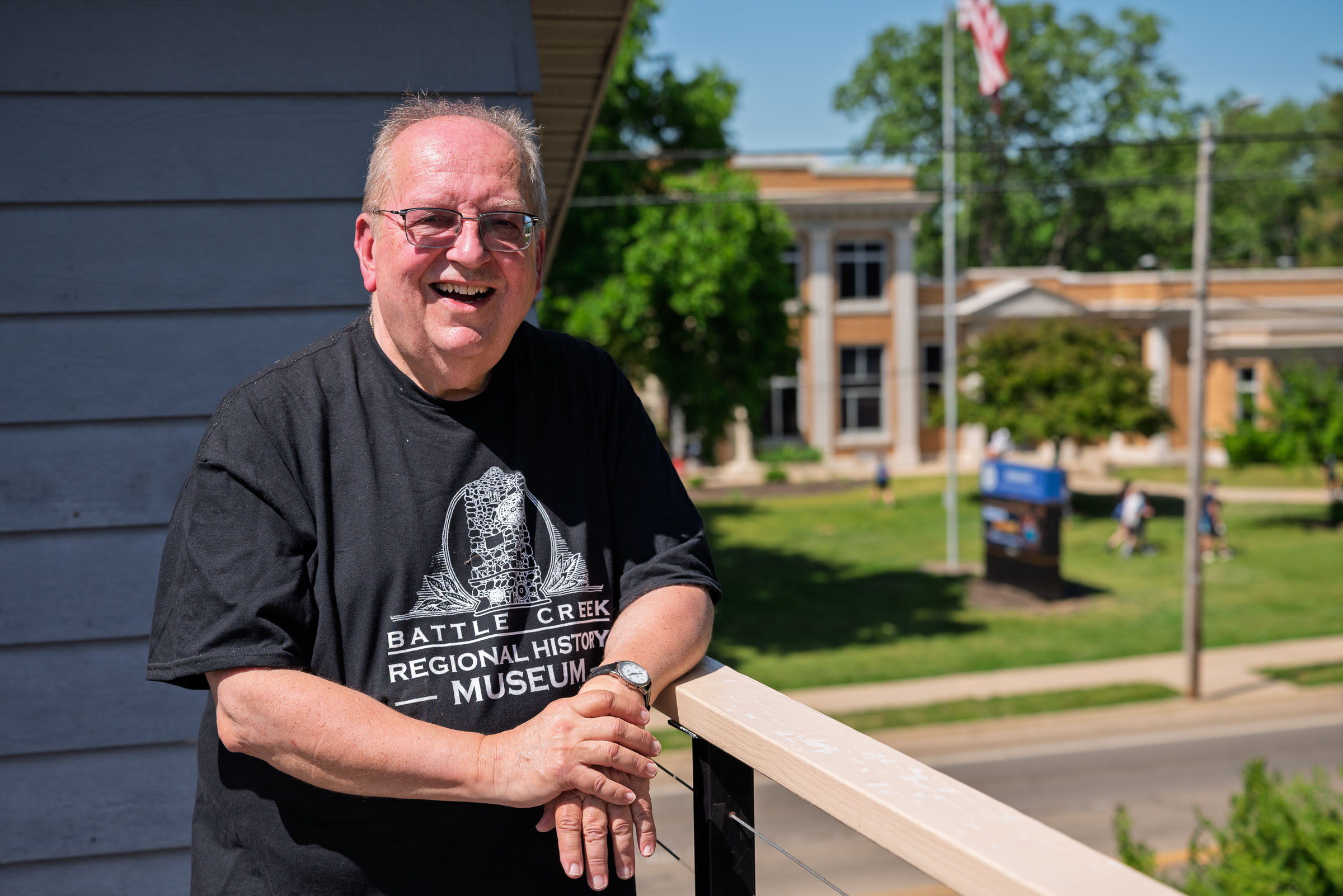
BATTLE CREEK — Kurt Thornton’s interest in Battle Creek history permeates his home. He has pieces of some of Battle Creek’s most famous buildings that have been torn down, turned into household display cases or a window between rooms. Visitors are treated to a museum experience as he points out his collections and what they mean to him.
History is central to who Thornton is. He is the author of numerous books of Battle Creek history and was a founding board member of the Battle Creek Regional History Museum. He currently sits on the Oak Hill Cemetery Board of Directors. He’s received recognition in the community for volunteer leadership and preserving local history.
The interest stems from his mom who was a historian in her own right, with a wealth of knowledge she was called upon to share and a massive Battle Creek photo library and postcard collection. Frances Thornton brought Kurt and his sisters along in her interest, taking them to historic moments in the city as they happened, like when the cement river was built downtown or the Post Tavern was torn down.
“My mom loved Battle Creek history and we were always involved in doing history stuff. Mom wanted us to be at these historic moments in Battle Creek,” Thornton said. “Mom’s love for Battle Creek history carried through to me and my two sisters.”
One thing Thornton learned from his mom is to stay organized. She had 40 boxes of Battle Creek history that weren’t organized. For instance, when she got a call about Martin Luther King Jr.;s 1960 visit to Battle Creek, the Thornton kids would have to go through all 40 boxes to find the pictures. He helped her to organize them later in life, now called the Frances Thornton collection.
The Frances Thornton collection is one archive Kurt uses to tell the stories of Battle Creek history for the community. He produces a video series on AccessVision called I’ll BCing You and an in-person presentation at the Battle Creek Regional History Museum. He also shares stories and answers questions with visual aids on social media. Across all platforms, Thornton shares Battle Creek history in a way that’s both informational and entertaining.
“I try to make them interesting and educational but sort of fun so you get more out of it more than just ‘yawn,’” Thornton said.
This storytelling highlights Thornton’s creative talents. He shares illustrations of Battle Creek landmarks and he sang the opening credits for I’ll BCing You — singing the Billie Holiday song to respect the copyright. It was his mom’s idea to use the song as a reference to Battle Creek — BC — and she didn’t get the chance. He thought his AccessVision series was a good opportunity.

Sharing The Complicated Stories about Battle Creek
Thornton helps people think about history dynamically. There are parts of Battle Creek history that are murky and maybe that was because there weren’t recording devices at the time or photographs. Times have changed, and how we see situations now might differ from how it might have been perceived at the time.
“(Dr. John Harvey) Kellogg did some crazy things, but no one was doing it. So he came up with these things — he also believed in fresh air, eating food that was pure, exercising. All the things that we now believe in, but he also believed in multiple enemas a day. But he believed it was right. He wasn’t doing it to torture people, he thought it was making you healthier,” Thornton said.
Thornton brings his inquisitive mind to all of the stories he shares, but tries not to judge. In a recent episode of I’ll BCing You about the history of Fort Custer, he addresses the irony of the way the land was once the utopian village Harmonia in the 1800s for Quakers and Spiritualists, where Sojourner Truth lived for 10 years before moving into Battle Creek. In 1917, the United States purchased 8,000 acres that included the village of Harmonia, to create what was called Camp Custer.
“Some structures from Harmonia were converted for use by the Army,” Kurt shares in the episode. And he shows pictures of Harmonia’s Methodist Church then converted into an automatic rifle school for Camp Custer.
Thornton has lived through a lot of Battle Creek’s history and he continues to participate in the vital conversations about the community’s history. He saw the rise and fall of Cereal City USA. The organizers came and spoke with his church about their plans before it opened, from facilities to community events. Then, “no one went and then it folded,” he shared. “When they had the auction [after it closed], you’re walking around thinking, ‘This should have made it.’” Thornton has some theories about why it didn’t, but he laments the opportunity to engage people in Battle Creek’s cereal history.
He’s seen a lot of change over the years in Battle Creek, and he understands when people feel remorse about historic buildings being torn down, like Southwestern Junior High School which is being demolished this month. A recent episode of I’ll BCing You shares the school’s history and what happened after it closed, which led to it becoming blighted.
He encourages people to consider what they want to save and get organized to do so. Referring to buildings being torn down, like Southwestern, Thornton said, “We can’t save that building but look around and if there’s some building that you see that has some architectural significance, it’s attractive, and you think it should be saved, let someone know. Sometimes your political leaders haven’t got a clue.”
Feeling Responsibility to Share This History
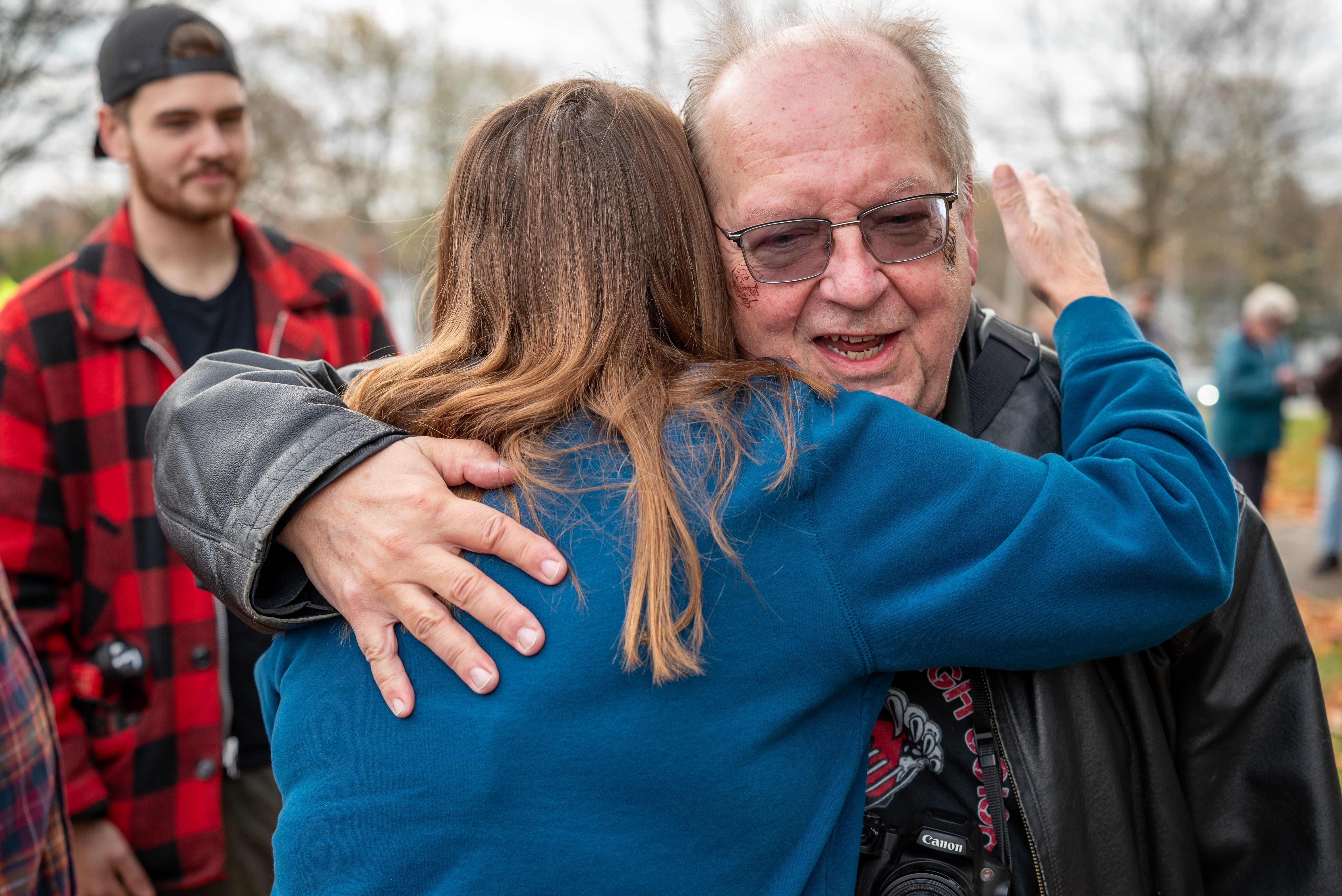
Thornton is passionate about sharing this history and not just holding on to it. He’s eager to share the photos that he and his mother have collected.
“Having them to myself? No,” Kurt shook his head. “It’s nice to get recognized for saving the picture but the big picture is I’d like to get them out there so someone else doesn’t have to rescan them or re-find them,” he said.
He doesn’t want to lose the history of this area, which he understands can happen when there aren’t stewards of the stories. That’s why he takes storytelling seriously.
“I keep thinking about the responsibility (of sharing this history),” Thornton said. “I need to do a good job instead of just saying things. I should pay attention to what I’m doing, which is why I went to AccessVision to do the program. I have all of this history and (some day) I’m going to die and it won’t get out there. Someone will have to refind it again, which is the thing I always hate about history is it goes through cycles and we have to relearn it.”
Thornton hopes that local history organizations can work together to help keep and share Battle Creek’s history. The Battle Creek Museum Alliance, which is made up of four local history organizations, has begun offering programming to share each organization’s individual strengths. He likes to imagine what is possible for sharing the area’s history.
“I’d like to see them make a museum that’s educational and entertaining so people will want to come and see it, and then they’ll want to come back. People will leave, but say, ‘I’ll go tell my friends and come back again.’ But they might go back two or three times because it’s so cool,” he said.
Thornton has ideas for how that might come together. In the meantime, he’s hopeful the community can come together to celebrate the City’s 200th birthday in 2031.
“I’d like to see us do something because in 1931 it was huge. They had the parade that lasted two hours through downtown and events happening all the time and this was at the height of the depression,” he said. He can only imagine what’s possible today.
Explore I’ll BCing You
- AccessVision, www.accessvision.tv
- YouTube, www.youtube.com/@BCingYou
- Battle Creek Regional History Museum, bcrhm.org/events.html
How We Reported This
This article is based off an interview with Kurt Thornton in his home, as well as a review of his biography, the I’ll BCing You series and his history-related social media posts.

Leave a Reply
You must be logged in to post a comment.