
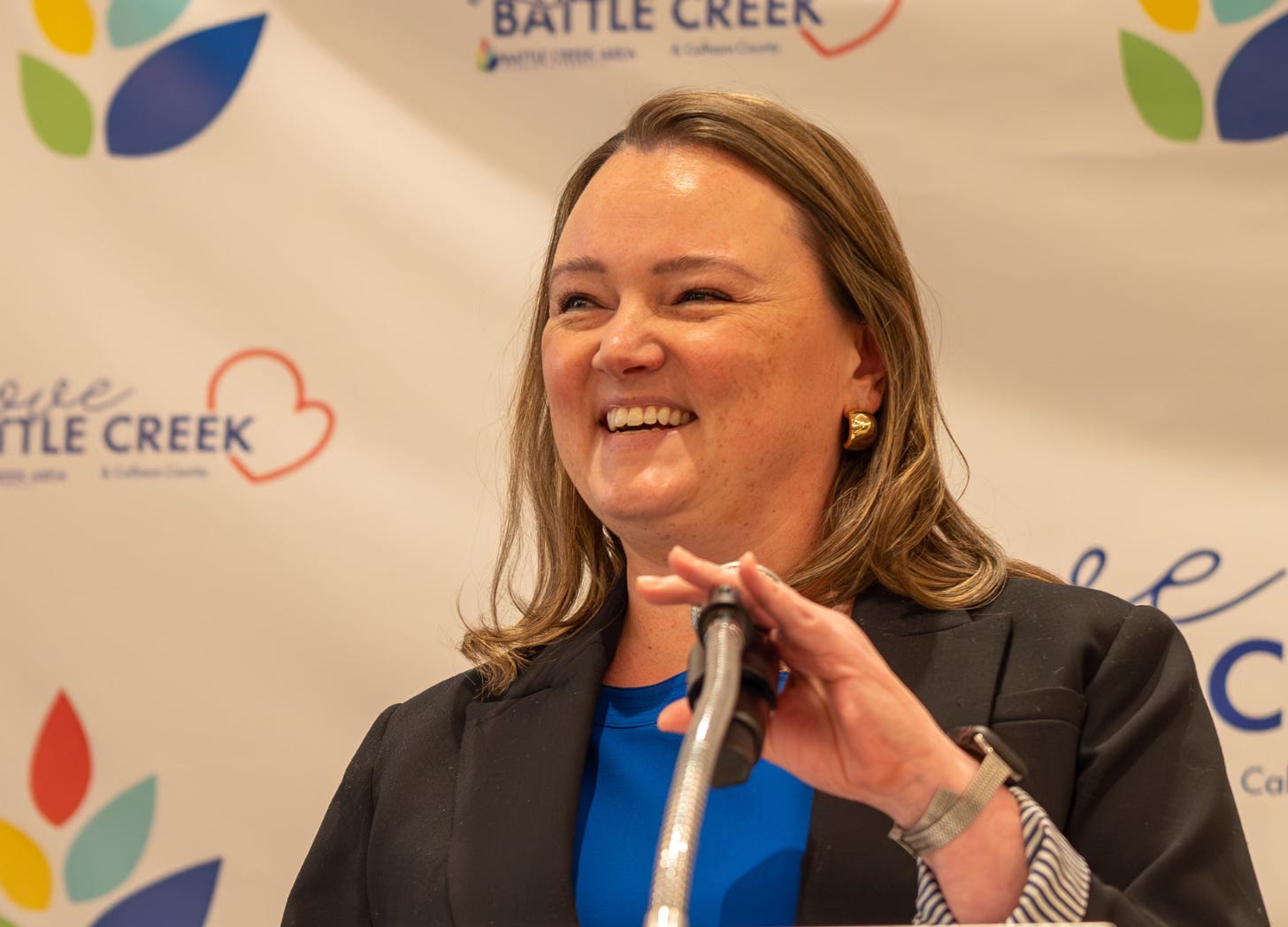
The new city manager talks priorities, development and leadership style.
Amanda Zimmerlin took over as Battle Creek City Manager in October 2025.
The Ohio native, who serves as the chief executive of city government, sat down with Downtown Battle Creek Zine to discuss her role, the city’s direction and long-term priorities.
The following conversation has been edited for length and clarity:
Downtown Battle Creek Zine (DBCZ): What made you see Battle Creek as a place you could lead?
Amanda Zimmerlin (AZ): “I wasn’t looking for a job… I picked up the phone and I called (Assistant City Manager) Ted (Dearing). I’m like, ‘Hey, tell me about Battle Creek, tell me what’s going on here. Tell me about the people.’ And of course, Ted being Ted, absolute champion in this city, he was honest…
“Driving around downtown and going through the neighborhoods, it reminded me of the neighborhoods my husband and I used to hang out in when we were younger… And the interview process — everything being very public — I’m like, ‘All right, that’s okay. Transparency is good.’ Listening to people, they all want the same thing. They just want what’s best for Battle Creek. Different views, different visions. And that’s okay. I’m like, ‘All right, this is a place that I can see me having a nice career.’”
DBCZ: You’ve said housing, child care and transportation are top priorities. Why those systems?
AZ: “Those are the three that have bubbled to the top in my short time here. They are the fundamental building blocks to a thriving economy, right? People need a place to live. Need transportation to work. And people need the ability to have their children cared for… Once you start building the strong foundation of that, you can build from there.”
DBCZ: How do downtown and the Beckley Road corridor fit together in the city’s growth?
AZ: “I don’t think it’s competing. I think it can be complementary. Sometimes the stuff that’s going to locate out there on Beckley Road, it’s not coming to downtown… But you’re probably not going to have as successful a space like Café Rica out there, because this is the type of place that’s your neighborhood coffee shop. You walk here…
“I think we can do both, and do both well — have a nice, vibrant downtown, and that more suburban shopping area. And even with the Beckley corridor, when you’re looking at the plan… it’s going to be a little more condensed, because it’s very open right now. The end goal is to bring everything a little tighter in, to make it a little more like a downtown than what it is.”
DBCZ: Battle Creek has long been known as “Cereal City.” How do you see the city’s identity evolving?
AZ: “I think that there is a migration away from it – not that we’re not ‘Cereal City,’ – but that there’s change. And with the sale of those two companies (W.K. Kellogg Co., Kellanova), we can’t put our eggs all in one basket.”
DBCZ: Battle Creek has a uniquely large concentration of philanthropic resources. How does that shape the city?
AZ: “We have a major international funder (W.K. Kellogg Foundation) sitting right here, you know, in the middle of our downtown… there are very few places that happen… being able to have that connection with them, and being able to just pick up the (phone), go, ‘Hey, can we talk about something?’ is great.
“But… it’s not like the city can continue to just rely on that. That’s not a good strategy to just go, ‘Hey, well, you know, the Kellogg Foundation is going to take care of it.’ Because it may not always be the case… while they’re a very valuable asset, I think that… there is opportunity to find some other strategies and other ways that we can make things happen too.”
DBCZ: What role do young people play in Battle Creek’s future?
AZ: “I think they play an absolutely vital role… I think if you want to make meaningful change in the community, that’s where you start, is with the kids. You start there. You start with shoring up that education, making sure that they have the tools that will allow them to go on into the workforce.
“And then you have things… bring it back to coming downtown. You have these events downtown. So when these kids graduate high school, they go to college, they want to come home, they want to come back here, right? So we don’t have that brain drain… rather than stay here and help this economy.
“I know that’s one of the things I want for my kids… I want them to have a good education, and I want them to be able to say, ‘All right, if this is the place where they spent most of their life, I want to go there. That’s where I want to stay. I want to raise my kids there.’ And I want that for Battle Creek.”
DBCZ: What does the Kalamazoo River naturalization project represent long-term?
AZ: “I think it’s fantastic. Keeping our community engaged with that… maybe the normal citizen isn’t paying attention… ‘Okay, I heard something was going to happen here at the river, but now it’s 2026 and nothing’s happened.’ I don’t think that there’s probably going to be meaningful… visually something people can physically see until at least after 2030 after that (EGLE) studies completed.
“But once that is done… not only will it revitalize the river corridor, I think it’s going to help with downtown… it kind of encapsulates the whole area as a walkable place… Could you imagine getting something here for lunch and then going over the river? I’m so excited. It’s going to be absolutely wonderful.”
DBCZ: How would you describe your leadership style?
AZ: “I think I’m a very collaborative leader… if I’m the smartest person in the room, we are in trouble… Instead of making decisions in a vacuum… we sit down, we talk, we vet things out… that collaborative leadership style… is going to help us get there.
“One of the things we do need to do is really look at getting back to some of our basic services… roads… water… basic core city services. Once we have that really shored up, then we can build out to the ‘nice-to-have.’”
This article is by Nick Buckley, from our partners at the Downtown Battle Creek Zine.

Leave a Reply
You must be logged in to post a comment.