
County has ranked near the bottom of Michigan for more than two decades
By Nick J. Buckley / For Black Squirrel News
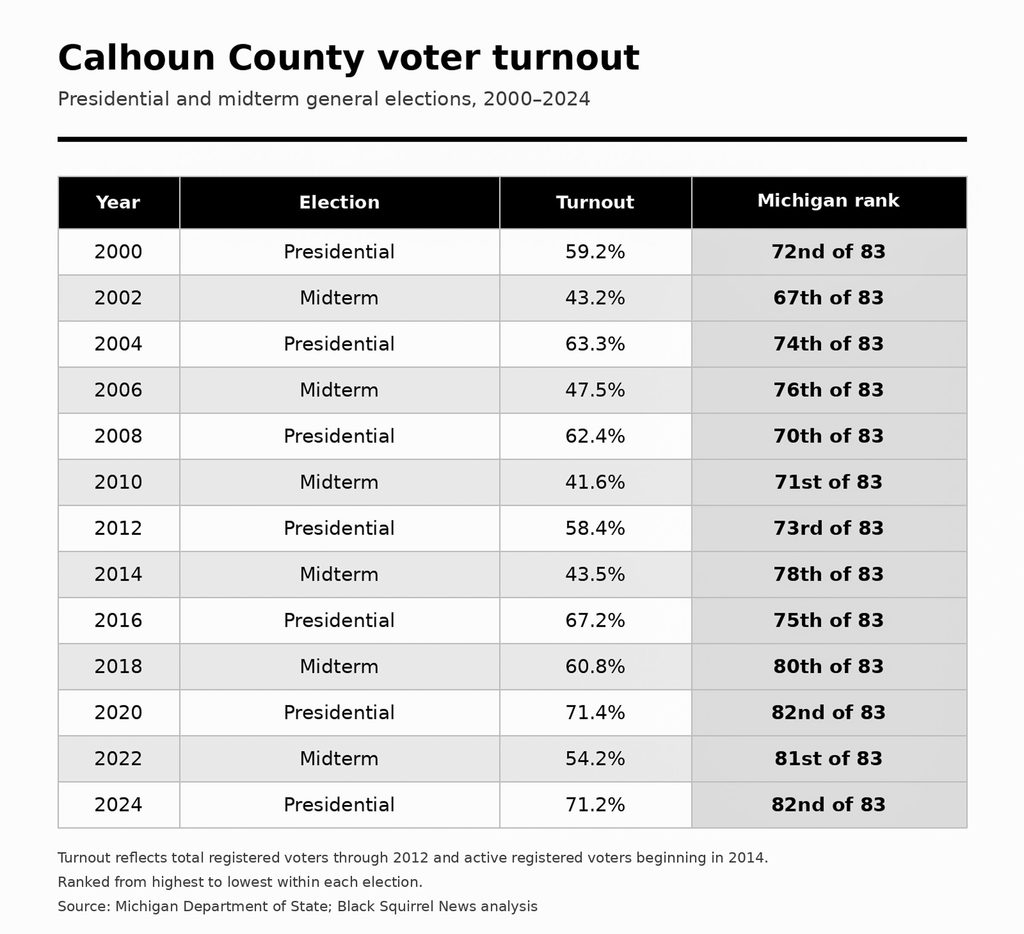
Calhoun County ranked second-to-last in Michigan for turnout among active registered voters in the 2024 presidential election.
That was not an outlier.
For more than two decades, Calhoun County has consistently lagged behind most of Michigan in voter participation. State election data show that since 2000, the county has never ranked higher than 67th among Michigan’s 83 counties in registered-voter turnout.
The trend continued in August 2026, when Calhoun County finished dead last among Michigan’s 83 counties in primary turnout, with only 22.3% of registered voters casting ballots.
Calhoun County Clerk and Register of Deeds Kimberly Hinkley hears several reasons people sit out elections, including dissatisfaction with candidates and distrust in the process.
“Some people don’t feel that their one vote matters,” Hinkley said.
The election numbers show a long-running pattern, but don’t explain why Calhoun County ranks below communities facing many of the same challenges. Local interviews, Census data and national voter research point to several possible reasons. Other factors are harder to measure, including whether local campaigns, civic groups and news outlets reach people who are not already engaged and whether residents believe local elections matter.
Economics
Nationally, voter turnout rises with household income. In the 2022 midterms, eligible voters in households earning at least $100,000 participated at twice the rate of those in households earning less than $20,000, according to the Census Bureau.
Some of Calhoun County’s largest cities also have poverty rates above the statewide average. From 2020 through 2024, the rate was 25.2% in Albion, 19.1% in Springfield and 17.6% in Battle Creek, compared with 13.2% statewide.
The August primary offered a neighborhood-level look at some of the pressures that can make voting a lower priority.
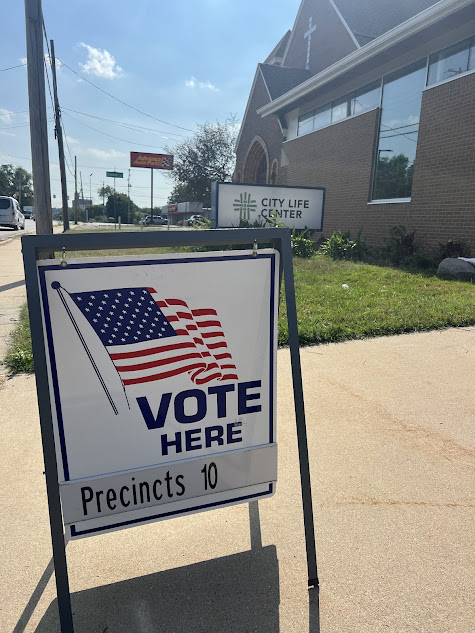
Following the election, We the People Michigan, a statewide community-organizing group, concentrated its outreach in the Post-Franklin neighborhood, which includes part of Battle Creek’s Precinct 7. This precinct had the county’s lowest turnout at 7.28%.
Jaimie Fales of We the People helped convene a countywide Get Out the Vote (GOTV) coalition that includes the League of Women Voters, A. Philip Randolph Institute Battle Creek, the Southwestern Michigan Urban League and the Burma Center.
Fales described Post-Franklin as a neighborhood with many renters and frequent turnover. For residents who move often, keeping voter registration current and knowing where to vote can become another hurdle.
Fales added that neighborhoods with consistently low turnout can receive less attention from campaigns, which often focus on areas where more people are expected to vote.
GOTV canvassers often encounter residents balancing jobs, children and other demands, leaving little time to learn about candidates. Fales recalled one resident saying, “I don’t vote. … It doesn’t affect my everyday life.”
Education and information
Voter turnout also rises with education level.
In the 2024 presidential election, 77.2% of people with bachelor’s degrees voted nationally, compared with 52.5% of high school graduates, according to the Census Bureau.
In Calhoun County, 22.9% of residents age 25 and older had a bachelor’s degree or higher from 2020 through 2024, compared with 32.5% statewide.
Hinkley said voter education also means understanding what is on the ballot and how local government affects daily life.
“People focus a lot more nationally than they do locally,” she said, adding that some voters “don’t understand how every election locally impacts them … in their day-to-day life.”
Access
Michigan voters can cast an absentee ballot without providing a reason, vote during nine days of early voting or go to the polls on Election Day, when they can also register to vote.
“Now, we really have no excuse to not have 100% voter turnout,” Hinkley said.
Transportation can still be a barrier for people who vote in person or return a ballot to a drop box.
Estimates from the Census Bureau’s 2020–24 American Community Survey showed 12.2% of Albion households and 10.7% of Battle Creek households had no vehicle available, compared with about 7% countywide and statewide.
RELATED: What to know about Ride Calhoun and the new Transit Authority
Access also includes accommodations for voters with disabilities.
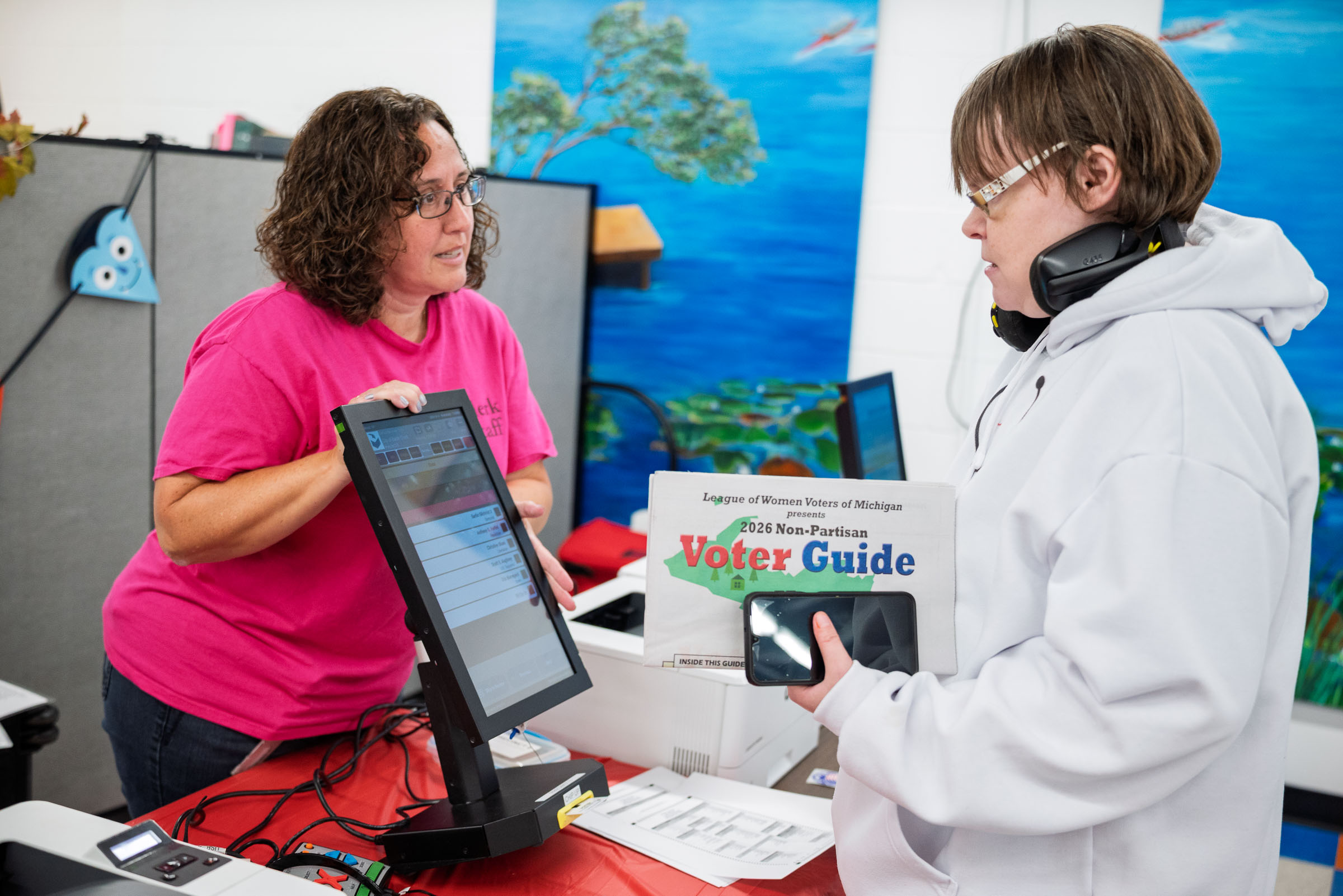
Hinkley said every county polling place meets federal accessibility requirements and has a voter assist terminal, though many voters do not know it is available. The device can enlarge text, adjust contrast, read the ballot aloud and accommodate adaptive controls before marking a paper ballot for tabulation.
Trust
Hinkley said distrust in elections is among the reasons residents give for not voting. Since the 2016 and 2020 elections, clerks have spent more time explaining election safeguards and clearing up confusion from national coverage.
Michigan voters use paper ballots, but Hinkley said some residents have called to ask why the state does not after seeing election coverage from elsewhere in the country.
Hinkley has encouraged residents who question the process to become poll watchers or election inspectors.
“When they saw all the checks and balances that our local clerks go through, and we do at the county level, they were like, ‘I don’t have to question it anymore,’” she said.
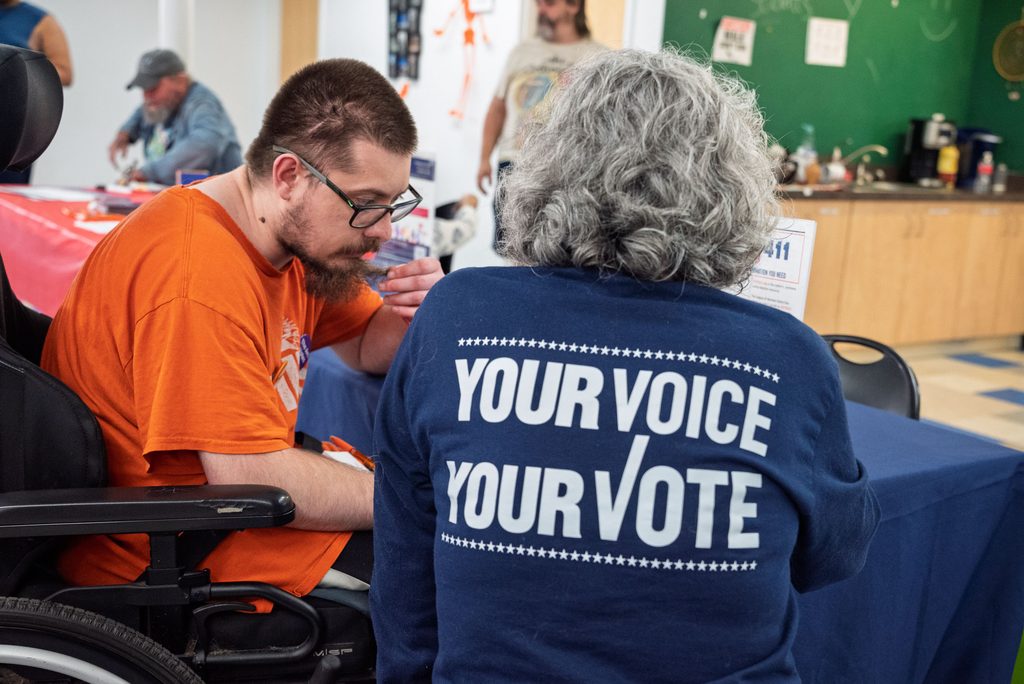
Distrust in candidates and politics can also keep people from voting. At the Oct. 14 Your Vote Matters event in Battle Creek, a Marshall resident who asked not to be named said she had not voted in years.
“I watch news and politics,” she said, “but when it comes to voting, ‘I don’t trust you.’”
How to vote in the Nov. 3 general election
- Register: Michigan residents may register online or by mail through Oct. 19. From Oct. 20 through 8 p.m. on Election Day, registration must be completed in person at the voter’s city or township clerk’s office with proof of residency.
- Vote absentee: Any registered Michigan voter may request an absentee ballot. Completed ballots must reach the voter’s clerk or an authorized ballot drop box by 8 p.m. Nov. 3.
- Vote early: Early in-person voting runs from Oct. 24 through Nov. 1. Locations and hours vary by community.
- Vote on Election Day: Polls are open from 7 a.m. to 8 p.m. Nov. 3. Anyone in line at 8 p.m. may vote.
For more information
Visit Michigan.gov/Vote to check or update a registration, view a sample ballot, find an early voting site or Election Day polling place, request or track an absentee ballot and locate a local clerk.
Calhoun County election information is available through the County Clerk and Register of Deeds.
Nonpartisan candidate information is available through the League of Women Voters at VOTE411.org.
How we reported this: Black Squirrel News analyzed Michigan Department of State turnout data for every presidential and midterm general election from 2000 through 2024, ranking all 83 counties within each election. Calculations use total registered voters through 2012 and active registered voters beginning in 2014. We also interviewed election officials, local organizers and residents and reviewed Census Bureau demographics and national voter research.

Leave a Reply
You must be logged in to post a comment.